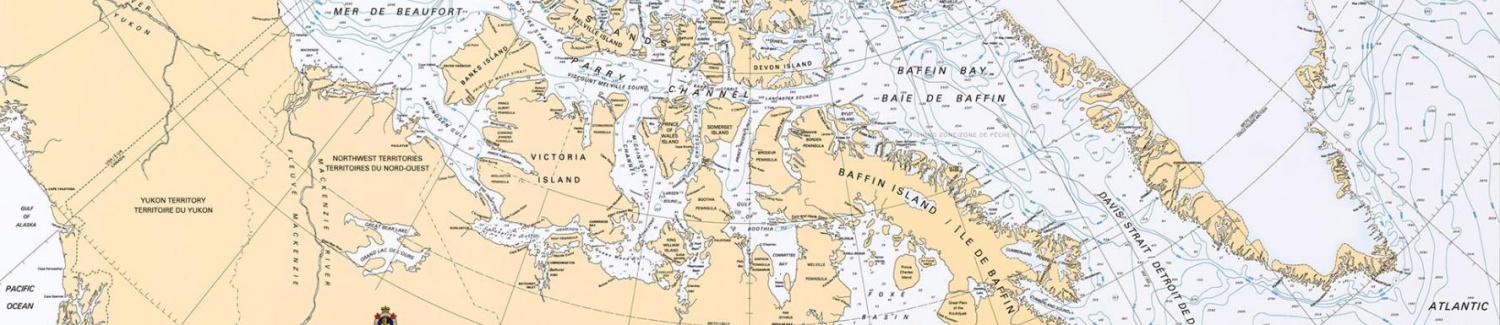
NORTHWEST PASSAGE TRANSITS TO END OF THE 2025 NAVIGATION SEASON
ATLANTIC OCEAN ↔ ARCTIC OCEAN ↔ PACIFIC OCEAN
R. K. Headland; with colleagues, friends, shipmates, and associates
revised 1 November 2025
Scott Polar Research Institute, University of Cambridge, Lensfield Road, Cambridge, United Kingdom, CB2 1ER.
<rkh10@cam.ac.uk> <rkh60m@proton.me>
Transits of the Northwest Passage proceed to or from the Atlantic Ocean (Labrador Sea) in or out of the eastern
approaches to the Canadian Arctic archipelago (Lancaster Sound or Foxe Basin) then the western approaches (McClure Strait
or Amundsen Gulf), across the Beaufort Sea and Chukchi Sea of the Arctic Ocean, through the Bering Strait, from or to the
Bering Sea of the Pacific Ocean. The Arctic Circle is crossed near the beginning and the end of all transits except those to or
from the central or northern coast of west Greenland.
The earliest traverse of the Northwest Passage was completed in 1853 starting in the Pacific Ocean to reach the Atlantic
Ocean, but used sledges over the sea ice of the central part of Parry Channel. Gjøa, the first vessel to accomplish a transit did
so in 1906. Subsequently the following 465 complete maritime transits of the Northwest Passage have been made to the end of
the 2025 navigation season, before winter began when the passage froze. The routes and directions are indicated. Details of
submarine transits are not included because only two have been reported (1960 USS Sea Dragon, Capt. George Peabody
Steele, westbound on route 1 and 1962 USS Skate, Capt. Joseph Lawrence Skoog, eastbound on route 1).
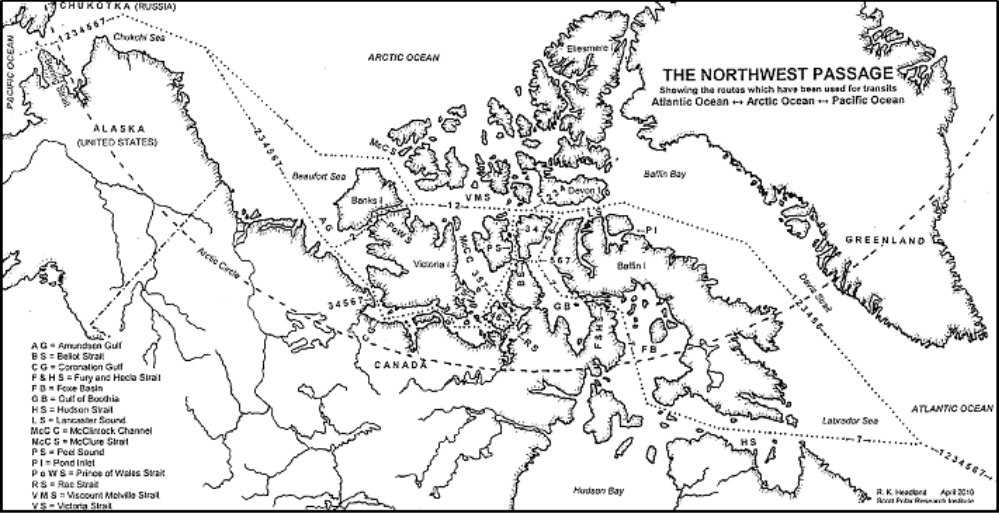
Seven principal routes have been used for transits of the Northwest Passage with occasional variations (for example south
round Bylot Island or north round Melville Island) and three composite courses in summers when ice permitted (marked ‘cp’).
These are shown on the map following, and proceed westbound as follows:
1: Davis Strait, Lancaster Sound, Barrow Strait, Viscount Melville Sound, McClure Strait, Beaufort Sea, Chukchi Sea,
Bering Strait. The shortest and deepest, but difficult and northernmost, way owing to severe ice in, and west, of McClure
Strait. The route is preferred by submarines because of its depth.
2: Davis Strait, Lancaster Sound, Barrow Strait, Viscount Melville Sound, Prince of Wales Strait, Amundsen G, Beaufort
Sea, Chukchi Sea, Bering Strait. An easier variant of route 1 which may avoid severe ice in McClure Strait. It is suitable for
deep draft vessels.
3: Davis Strait, Lancaster Sound, Barrow Strait, Peel Sound, Franklin Strait, Victoria Strait, Coronation Gulf, Amundsen
Gulf, Beaufort Sea, Chukchi Sea, Bering Strait. The principal route; used by larger vessels of moderate draft.
4: Davis Strait, Lancaster Sound, Barrow Strait, Peel Sound, Rae Strait, Simpson Strait, Coronation Gulf, Amundsen
Gulf, Beaufort Sea, Chukchi Sea, Bering Strait. A variant of route 3 for smaller vessels if ice from McClintock Channel has
blocked Victoria Strait. Simpson Strait, although buoyed, is only 6·4 m deep, it has shoals with complex currents.
5: Davis Strait, Lancaster Sound, Prince Regent Inlet, Bellot Strait, Franklin Strait, Victoria Strait, Coronation Gulf,
Amundsen Gulf, Beaufort Sea, Chukchi Sea, Bering Strait. This route is dependent on ice in Bellot Strait which has complex
tidal currents.
6: Davis Strait, Lancaster Sound, Prince Regent Inlet, Bellot Strait, Rae Strait, Simpson Strait, Coronation Gulf,
Amundsen Gulf, Beaufort Sea, Chukchi Sea, Bering Strait. A variant of route 5 for smaller vessels if ice from McClintock
Channel has blocked Victoria Strait. Simpson Strait, although buoyed, is only 6·4 m deep, complex currents run in it and in
Bellot Strait.
7: Hudson Strait, Foxe Basin, Fury and Hecla Strait, Bellot Strait, Franklin Strait, Victoria Strait, Coronation Gulf,
Amundsen Gulf, Beaufort Sea, Chukchi Sea, Bering Strait. A difficult, but shorter, route owing to severe ice west of Fury and
Hecla Strait and currents of Bellot Strait.
Approximate distances between 60°N, 60°W in the Labrador Sea and 65°N, 169°W in Bering Sea are: route 1, 5300 km
(2860 n.m.); route 2, 5700 km (3080 n.m.); route 3, 6300 km (3400 n.m.); route 4, 6600 km (3560 n.m.); route 5, 6200 km
(3350 n.m.); route 6, 6500 km (3510 n.m.); route 7, 6100 km (3290 n.m.).
The list is in alphabetical order of vessel names in the years of completion of the voyages (the reference numbers do not
necessarily indicate precedence). Superscript numbers in the list are cumulative numbers of individual vessels, commands,
flags, etc. Annual summary numbers of transits are indicated by Ʃ followed by a generalised division in four categories.
An analysis of the transit routes used through the Northwest Passage to the end of navigation in 2025 shows:
| Route 1 | West | 5 | East | 0 | Total | 5 |
| Route 2 | West | 14 | East | 5 | Total | 19 |
| Route 3 | West | 67 | East | 40 | Total | 107 |
| Route 4 | West | 56 | East | 12 | Total | 68 |
| Route 5 | West | 57 | East | 59 | Total | 116 |
| Route 6 | West | 61 | East | 59 | Total | 120 |
| Route 7 | West | 12 | East | 15 | Total | 27 |
| Route Composite | West | 2 | East | 1 | Total | 3 |
| Overall | West | 274 | East |
191 |
Grand Total |
465 |
Transit Routes:
Statistics:
Complete transits have been made by 317 different vessels (several with changed names), 31 of these are icebreakers
which have made 60 transits. Kapitan Khlebnikov has made 18 transits, Hanseatic 11, Bremen 10 (2 with the former name,
Frontier Spirit), Polar Bound 9, 1 vessel has made 6, 3 vessel made 5, 4 have made 4, 17 vessels have made 3, and 38 have
made 2. More than one year was taken by 34 of these vessels, mainly small craft, to complete a transit wintering at various
places along the route (complements of some left for winter returning in a later navigation season). Return transits in one
season have been accomplished by 14 vessels. The vessels are from 46 registries: 62 Netherlands; 53 Canada; 49 France; 48
United States; 47 Bahamas; 32 Britain; 26 Russia; 18 Cayman Islands; 15 Norway; 14 Germany; 9 New Zealand; 8 Malta and
Poland; 7 Australia, Marshall Islands, and Sweden; 6 Finland and Switzerland; 5 Austria and Belgium; 3 Denmark; 2 Antigua
and Barbuda, Brasil, Cook Islands, Jamaica, and Panama; 1 from Barbados, China (Beijing), Croatia, Curaçao, Czechia,
Estonia, Greenland, Hong Kong, Hungary, Ireland (Dublin), Israel, Italy, Japan, Liberia, Nouvelle Calédonie, Singapore,
Slovakia, Slovenia, South Africa, and Spain.
Specific passenger vessels have made 100 transits, but only 56 transits conveyed commercial cargo or fuel (48 being
Wagenborg vessels). Others were for repositioning and supply, research, or other work. 14 vessels circumnavigated the Arctic
Ocean, entering the Pacific Ocean before or after transiting the Northern Sea Route (Northeast Passage). Only the Master’s
name (the Captain, or Skipper aboard small craft) is given (in full when known). Of these David Scott Cowper has
commanded 10 transits, Viktor Vasiliev 8, Heinz Aye and Piotr Golikov 6, Étienne Garcia, Patrick Marchesseau, and Thilo
Natke 5. Single-handed transits have been made on 17 occasions.
Several other vessels, including recent small craft, have traversed the Canadian Arctic archipelago, Beaufort Sea and
Chukchi Sea to or from Russian waters. Those which neither transited Bering Strait nor entered the Pacific Ocean are not
included in this list, although some circumnavigated the Arctic Ocean. Many other voyages have been made through the
archipelago of the Canadian Arctic, notably the return voyage of the experimental oil tanker Manhattan with escort vessels
which reached Barrow, on the Arctic coast of Alaska, in 1969 from the Atlantic Ocean, but did not continue to the Pacific
Ocean before returning eastbound. Similarly constraints are applied to voyages which ended in Pond Inlet, the region of the
Mackenzie Delta, or comparable locations, where a vessel was towed while unoccupied, or carried partly as deck cargo
(including Baymaud, 1926-2017). These can not regarded as complete transits of the Northwest Passage; incomplete transits
have become too numerous to record. Nationalities: principles adopted for these are the approved English short forms applied
by several international organizations and published by The Times Atlas.
Sources include a compilation by Thomas Pullen and Charles Swithinbank published in Polar Record (1991), with advice
from Frank van den Anker (Wagenborg), Lawson Brigham (USCG), Peter Capelotti (USCG), David Cowper (Fort Ross
visits), David Fletcher, Steffen Graupner, Al Guadagno (Wagenborg), Chris Havern (USCG), Jean-Pierre Lehnert (CCG),
Guus van der Linde, Brian McDonald (CCG), John MacFarlane, Fred McCague, Marcel Pera (Biglift), Ashley Perrin, Richard
de Rijk, (Wagenborg), Louis Robert, Peter Semotiuk, Tony Soper, Patrick Toomey (CCG), Victor Wejer, Fred Williams, and
Christopher Wright, personal observations made during several transits, many publications, advice from persons directly
involved and several internet sites (with various degrees of reliability).
Data: the list is subject to annual revision with review and confirmation as additional information and improved
details are received. Occasionally, and unfortunately, falsified data have been submitted; when detected these are expunged
and the record revised. Advice of corrections and additions, as well as of subsequent transits, is appreciated;
<rkh10@cam.ac.uk>. A copy of the latest iteration is available from the same source. This may also be found, summarized
after the end of a navigation season and with the latest data, on https://www.spri.cam.ac.uk/resources/infosheets/.
Transit Summary List: